Wednesday, April 25, 2012

Hitting the Hill for National Library Legislative Day


On April 24th more than 350 librarians and library supporters gathered in Washington, DC, for the National Library Legislative Day. I was lucky enough to represent South Carolina school libraries and the SC Association of School Librarians with Fran Bullington. Fran and I were part of a nine person delegation visiting the offices of our Congressmen to encourage them to support federal funding for school, public and academic libraries.

The three initiatives discussed with each of our eight Congressmen were requesting level funding for the Library Services and Technology Act (LSTA), level funding for the Innovative Approaches to Literacy (IAL) grant, and inclusion of provisions for a school librarian at each school in the reauthorization of the Elementary and Secondary Education Act (ESEA).

Every SCASL member is encouraged to email, phone or tweet to his/her Congressmen thanking them for meeting with SCASL and reminding them of these initiatives.

I enjoyed the opportunity to represent our state and savored my time with Fran. I hope I didn't annoy her too much as we chatted about our libraries. It was so nice to have another librarian to talk to and bounce ideas off of.

Wednesday, April 11, 2012

Nonfiction Under the Microscope

As Common Core approaches nonfiction is becoming a hot topic for librarians. There are many articles on the topic. Some are here, here, and here. In case you haven't delved into the standards yet, you should be aware that students are expected to be reading about 50% fiction and 50% nonfiction in school by 8th grade. In high school the shift is 70% nonfiction and 30% fiction. This does include the content areas so you should still find a healthy dose of literature in English Language Arts.

The nonfiction focus does require preparation for librarians. We need to expect more use of our nonfiction resources. There are several tasks that we need to complete in order to be ready.

1. Weed your nonfiction.
Weed, weed, and when you think you are finished, weed some more.
Here are a few guidelines for weeding your collection. This is an excellent list of resources about weeding from ALA. One trick that has helped me is finding an excellent student helper (don't we all have at least one that stands out) and ask them to pull books from one area that they would get rid of. Then look through those titles. You have the final say because you know about projects, interests of all the students, and classics that you feel you should keep, but you will get a student perspective. That student doesn't care that you remember this book from your childhood or remembered purchasing the book. They will give you an honest opinion.
Many librarians are nervous about having empty shelves, but a wise professor in my master's program told me that as long as you have full shelves administrators will believe that you have plenty of funds. There is no reason to keep outdated, unused books if the only purpose is to fill up shelves. Research shows that weeding increases circulation because it gets the "junk" out of the way and students can see the "good" books. If you are still nervous, start with one small area and see how it goes.

2. Evaluate and share the results.
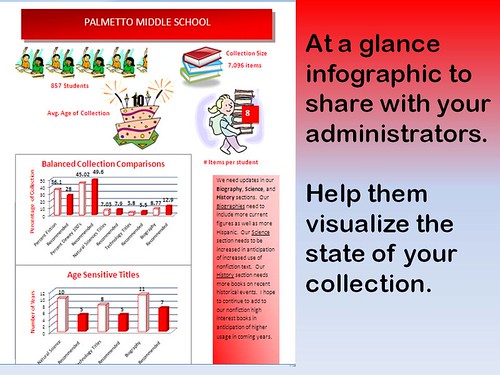
After weeding, you need to evaluate your collection. Make notes of areas and topics that you feel require additional titles. Invite your teachers to come in and give suggestions. Discuss projects, both present and future, and resources they will need for those projects. Run a collection analysis and see how you compare to recommendations. Don't just keep this information to yourself. Share this with administrators so they know the state of your collection and your needs. In our district we created one page infographic-style reports for each school and sent them to our superintendent in the hopes of receiving funds to update for the Common Core. We received a positive response. Thank you, Monique German for putting them together for us!

Nonfiction infographic

3. Purchase high interest nonfiction titles.
No matter what your budget is you will need to do your best to update your titles. I have found the recommended titles on many Common Core sites to be lacking so I have been attending webinars and reading blogs to get ideas for high interest nonfiction. I have created a Pinterest board of books within recommended range, both fiction and nonfiction, if you need a few ideas. If you want to contribute to the board email your Pinterest ID and I will add your name. I recommend following Nonfiction Monday for more ideas.

4. Nonfiction Promotion
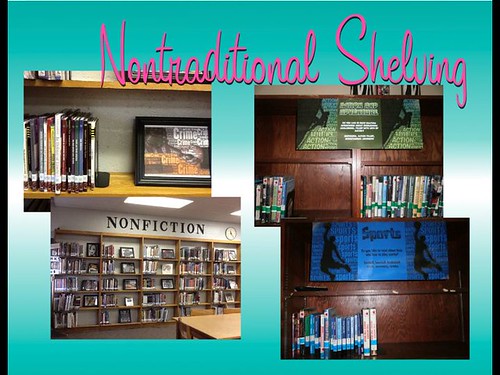
Now that you have an updated area you need to market the material. Jennifer Lagarde has several excellent recommendations here like nonfiction book clubs, author visits and book displays. Book talk your nonfiction and share book trailers. I have been able to find inspiration on Pinterest, especially Fran Bullington's library display board. If you search "library displays" this is the list you find of boards with this title. There are several to choose from that should help you find a few creative ways to display your books. Consider creative arrangements that will make the area student-friendly. If you read this blog, you know I ditched Dewey, but if that is too extreme you can also increase signs and put books cover out to attract students to the area.

I know you have your own ideas and suggestions about preparing your nonfiction collection for Common Core. I would love to hear them. What am I missing?

Sunday, April 8, 2012

Novels to Know: Middle School Edition


As part of our preparation for Common Core standards our district asked the librarians to put together a list of noteworthy novels that would help meet the higher standards for text complexity and reading level. My two middle grade partners, Monique German and Kristen Hearne, and I will be putting together the list for our level.
Priority number one for me was to become as much of an expert on Common Core as I can so I have been spending time learning the details of our new standards.
If you haven't read the details on how texts are evaluated I highly suggest reading Appendix A of the standards document. There are three considerations when evaluating text: quantitative, qualitative, reader and task. Quantitative can be measured with Lexile or a similar tool. Qualitative includes text complexity and is fully explained in Appendix A. Reader and Task focuses on whether the book is appropriate for the student's age and purpose of the lesson.
To look at a diagram comparing current Lexile bands by grade and the "stretch" bands for Common Core visit the Lexile site. For middle school we went from 860L-1010L to 955L-1155L. The Common Core suggested reading list for these grades can be seen here.
This list does not impress me. Maybe it is because I have only read three items from the list. Oops. Should I admit that? I also found this list, which was better and more current.
I have been deliberately choosing books lately with this in mind. I wanted to find current books with kid appeal that meet these recommendations.

These are my top picks:

Bluefish by Pat Schmatz: The Lexile is only 600, but the text complexity makes it a contender. There are allusions to other text, events were often out of chronological order, and told in multiple perspectives. This title is a good choice for middle grades because there is humor, friendship and family drama. I believe that many teachers would find the story appealing as well. This would be an easy sell.

Wonder by RJ Palacio: The Lexile is 790. The story is told in multiple perspectives with several flashbacks and addresses sophisticated themes. This book is an excellent choice for higher elementary and early middle grades because of the subject matter. This is another choice that I believe would appeal to the majority of students and teachers. In my opinion this book should be required reading for everyone. It is that good.

Dead End in Norvelt by Jack Gantos: The Lexile is 920. This is still not quite to the level recommended, but the qualitative measures make this quite a complex book. The figurative language, irony, multiple sophisticated themes, and levels of meaning make this an excellent choice. This was the Newbery winner for 2012 and well deserved. The teachers will probably enjoy it right away, but some of our students will most likely need scaffolding to understand and appreciate this book.

Okay for Now by Gary Schmidt: Lexile of 850. High qualitative measures similar to Dead End in Norvelt. It includes a high level of complexity, multiple themes and perspectives and sophisticated graphics that propel the plot.

Inside Out and Back Again by Thanhha Lai: Lexile is 800. Qualitative measures are off the charts because of complex themes, unique perspectives, and unconventional structure. I believe this book would be a great choice for literature circles because it doesn't have the same wide appeal as some of the other titles, but there are definitely students that will love this one.

Addie On The Inside by James Howe: The Lexile isn't published, but I think it is similar to the companion book, The Misfits, which comes in at 960. Finally one within the recommended range. The qualitative measures for this one are where they should be with multiple sophisticated themes, complex structure and figurative language. Again, this would be an excellent literature circle choice.

Others for consideration:
A Monster Calls by Patrick Ness
The Mighty Miss Malone by Christopher Paul Curtis
Out of My Mind by Sharon Draper
Wonderstruck by David Selznick
Countdown by Deborah Wiles
Watch That Ends the Night by Allan Wolf
Crow by Barbara Wright

I know some of you are wondering about nonfiction. If you are wondering, good for you. You know a little about Common Core. We will be putting together a list of recommended nonfiction titles, but I wanted this post to focus on the fiction.
We do have a working list of nonfiction pairings with our state book awards as well as websites and book trailers.
In addition to addressing Common Core at this particular session we will be discussing titles that we feel our ELA teachers should know about. We are putting together lists by genre or interest level such as dystopian, titles for reluctant readers, sports, zombies, creepy, something for our sweet 6th grade girls, novels in verse, hilo and more. We are going to create bookmarks with titles listed for them to reference later. I'll share these when they are ready.
Unfortunately even some English teachers do not read often (or read middle grade and YA novels) so we hope to help them be aware of trends in fiction and learn more about current titles that their students will enjoy.

Recently on our state listserv there were complaints that all of the recommended book lists for Common Core were out of date. In response I created this Google Doc in the hopes that our collective wisdom and effort could create a better list. So far it is mostly the middle school librarians from my district that contributed 6-8th grade titles, but here's to hoping. Feel free to add to the list and share.

Since we're talking about books I wanted to share the many wonderful titles I read during Spring Break:
Balloons Over Broadway, The Friendship Doll, The Great Wall of Lucy Wu, Hound Dog True, Lemonade, Shout! Shout it Out!, The Humming Room, Inside Out and Back Again, Addie on the Inside, Bluefish, Dead End in Norvelt, The Whisper, Through My Eyes (Young Readers Edition), The One and Only Ivan, Storm Runners: Eruption, Stupid Fast, Cinder, The Fourth Stall and Press Here. I've started The Scorpio Races, but doubt I'll finish before we return. It was a great time for reading.

What books should be on my Common Core list? Did you read anything wonderful over your Spring Break?


Saturday, March 31, 2012

No Dewey?! The Horror

My post on ditching Dewey has remained one of my most viewed posts even though it is months old. Living without Dewey is so normal for me now that I forget how unusual it can be for those just considering the idea. When Tiffany Whitehead and I presented "Be a Next Gen Librarian, Today" at the Follett New Leaf in Learning Conference we included nontraditional shelving in our suggestions. I spoke about changing nonfiction and Tiff shared her genre organized fiction area.

NextGen.038
*Her slides are so cute! We should all email Tiff to encourage her to share her genre signs on Flickr:)


As soon as we brought up the slide and quickly shared how we implemented this concept in our libraries the room was abuzz with conversation. I think every person in the room turned to their neighbor to talk. Not sure if it was intrigue or shock, but either way I was happy to get conversations started and wheels turning. This presentation was the first full day of the conference, but the rest of the time there we had people coming up asking us more about it. Since then I've had a few emails forwarded to me sharing Dewey conversations from library associations in other states. I love that so many people are talking about it.
I believe Dewey is one of our sacred cows, which is why this topic causes such a stir. While I am very happy with the change I realize that this isn't for everyone. I'm not suggesting everyone should go out and do this today. There are many levels to this change if you aren't ready to completely ditch Dewey. You could create better signs, add genre or subject labels, or only pull out certain sections and still keep Dewey. You can adapt it to your needs.
What really excites me about these conversations is that librarians are evaluating tradition and deciding whether or not to keep, adapt, or throw out ideas that are no longer relevant to our students' needs. This is exactly what we must do to stay indispensable.
I thought it might be a good idea to start putting resources together when people ask about this so I created a topic on Scoop.it called Dewey Free Library. Feel free to add to the topic and share with others.
I welcome anyone with questions, concerns, and ideas about nontraditional shelving. Just don't try to convince me to go back. Ain't gonna happen!

Wednesday, March 28, 2012

Hunger Games Celebration


I know there are some amazing parties and events going on around the country in public and school libraries, but I'm going to share my little party even though it was a small event.


We celebrated the movie release with a teacher and student costume contest. I was so impressed by the students' creativity. The student winners were Greasy Sae, a Peacekeeper, Katniss at the reaping and the Girl On Fire interview costume. The teacher winners were three Capitol citizens and an Effie. Above is my version of Effie and one of the teacher winners. They won movie posters and the Hunger Games Read poster for the teachers.

I created a book trivia sheet that the students could answer to win a Mockingjay pin. There was one student that got all of them correct. I guess my questions were pretty tough.

I set up tribute trial stations in the library during lunch. We had a camo matching game, knot tying station, edible or inedible plant game, Nerf archery, push up contest for strength, and the Hunger Games online game on the computers.

Our assistant principal also made some fiery cupcakes.

The students had fun during lunch and I even received a few hugs and thanks for organizing the party.

Poetry Picnic


I am always on the look out for poetry lessons because I have not found a lesson that really interested the students, until now. On my newest addiction, Pinterest, I saw this link. Even though this lesson was originally for elementary age students I tweaked it a bit and my students loved it.


I had twelve stations and my 6th graders really enjoyed it. My descriptions would be so similar to the original site I'm going to list each station and just include the changes I made for middle school. I urge you to visit the site where she provides instructions and links that you will need.


List Poetry-Same as original


Poetry Tag on the Kindle-I brought my Kindle Fire from home because our school Kindles are used daily in our resource classrooms.


Poetry on the iPods: Students used the Poem Flow app and Verses magnetic poetry app. Both free!


Poetry Place Mats-instead of having students weave a placemat I printed a coloring sheet of a placemat for them to write their poems on.


Origami Poetry-Same as original


Shape Poems-This was the students favorite.


Songs- I didn't need the books here. I pulled up this Fun Clapping site and they took it from there. Warning: These are Youtube videos so I had to log into the computer as me so that they could view them. I was pleasantly surprised at the number of boys that enjoyed this station.


Fun With Words: Students ignored the books, but loved playing the game, Hink Pink.


Poetry Splatter: Same as original. They love anything that lets them play on the Smartboard.


Poetry With Friends: Same as original


Poetry Websites: I used three of our netbooks from a mobile cart for students to explore these websites.

Lemonade: I did have a magnetic board and letters, but I ended up using the tiles from Bananagrams (originally in Fun With Words) because there were more letters to choose from.


Items I had to purchase: red and white tablecloths, Bananagrams, Hink Pink


If I didn't already have the book I borrowed them from the public library until I knew this would be an activity that I would repeat. I plan on purchasing several titles to have available for the future.


I'm sorry if my explanations are vague, but I think it is best if you visit her site because she obviously put a lot of work and thought into organizing this.


If you are looking for a fun activity for Poetry Month I suggest giving this a try. The students and teachers had a ball.

Sunday, March 25, 2012

#holdshelf Project

Have you participated in the hold shelf project? Blog, email or tweet a pic of your hold shelf so we can all see what kids are really reading.
Here is my hold shelf.
If you want to participate tweet a pic with the hash tag #holdshelf or email to scopesnotes at gmail dot com.